
Is what you’ve been taught about biases wrong?

Short of time? Read the key takeaways.
🎰 The gambler's fallacy isn't always a fallacy. At a roulette wheel, past losses don't make a win more likely. But when outcomes aren't reset, a streak of losses can genuinely raise your odds. However...
🔄 Sometimes, losing predicts more losing. If you've been on 50 bad first dates in a row, your next one probably won't go well.
🧪 Biases tested in hypotheticals may not reflect real life. Biases like the gambler's fallacy are the result of heuristics honed by evolution and daily experience that are not easily captured in artificial puzzles. For example, people neglect base rates significantly less when the same information is presented in the the form of natural frequencies. This might explain some of the mismatch between research findings and what we'd expect from rational people.
🧠 Humans are still often genuinely irrational. All of this means that we need to be careful when attributing cognitive biases, because some heuristics may be smarter than they seem. That being said, believing the gambler's fallacy in Las Vegas or taking 30% interest loans against your interest are real mistakes worth avoiding.
I bet that you think you’re pretty rational. Well, we’ve got a puzzle for you. It might sound kind of simple, but watch for the trick.
This article is adapted from one of the latest videos by Spencer Greenberg (founder of Clearer Thinking). It has been slightly expanded in places and has had relevant citations added, but if you’d rather watch along, you can do so here:
Now, here’s the puzzle. Suppose you have a bag of marbles. Half of the marbles are red, and half of the marbles are blue. If you draw a blue marble out of the bag, you get a dollar. If you draw a red marble, you get nothing. Suppose you know that each draw is completely at random. But the first five times you draw a marble from the bag, you get red each time.
Given that, what’s the chance the next marble is blue?
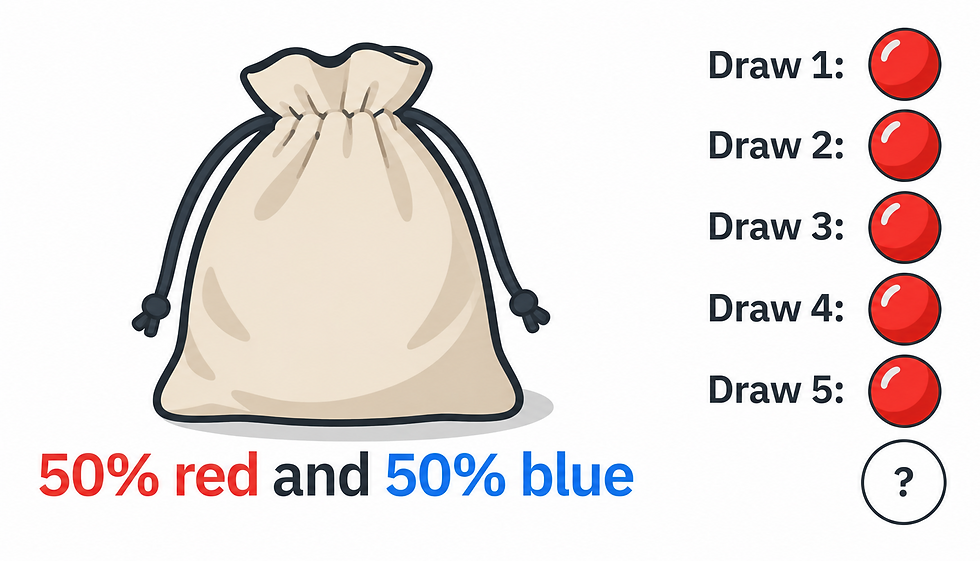
Take a moment to think about it. Lock it in. Have you got it?
What We Didn’t Say In The Marble Puzzle
You’re probably wrong. But if you are, don’t worry: most people get it wrong. That’s because the right answer could be anything from 50% to 100%. Critical information has been left out of the problem, which prevents you from solving it. And this idea of missing information ties in to an important debate that’s going on about how rational humans are.
If you assume that you put each marble back in the bag after drawing it (and before your next draw), the answer is 50%. That’s because you restore the bag to its original state after each draw, and there’s a 50% chance of the next drawn marble being blue in the original state.
However, it was never stipulated that the marbles are placed back in the bag. Suppose that they aren’t, and there are 10 marbles to start (five red and five blue). After drawing five red ones in a row, there are no red marbles left. That means there’s a 100% chance that your next draw is blue!

But that’s not the only other answer. If the marbles aren’t placed back in the bag after being selected, then the probability of your next pick being a blue marble will depend on the number of marbles there were at the start. With 10 starting marbles, the probability of the next marble being blue is 100%, but as you increase the starting number, the probability of the next marble being blue gets closer and closer to 50%.
But what does this question have to do with rationality?
Cognitive Biases or Rationality in Disguise?
You’ve probably heard about cognitive biases; they’re ways that our minds are riddled with systematic irrationalities. There are more than 100 cognitive biases that have been documented. But what if they aren’t real? Newer research (such as here and here) has suggested that some of these cognitive biases may not be biases after all. Could they actually be rationality in disguise?
Let’s take a look at one bias more closely, to see how this could be the case.
The Gambler’s Fallacy Explained
You may have heard of the gambler’s fallacy. It’s the intuition many people naturally have that if you’ve lost many times at something, you’re “due” to win. In other words, with more losses, the probability of a win increases. Many people have a deep intuition that the more times they lose on a roulette wheel (for example), the higher the probability it is that they win on the next spin.
But at the casino, this is unequivocally a fallacy. The reason is that every time you spin the roulette wheel, it's starting over fresh. It has no memory of the past. So there’s no way that the probability could depend on what happened before.
The gambler’s fallacy isn't just about gambling, though. People’s intuition is that it applies all over the place. They might think:
“Oh, if I've had two baby girls, the next one’s bound to be a boy.”
“If it’s been three rainy days in a row, the next one’s bound to be sunny.”
“If I’ve gone on 20 bad dates, my luck is due, and the next one is bound to be a good one.”
However, before we write off humans as irrational because we fall for the gambler’s fallacy, it’s worth wondering, “why do people have that intuition in the first place?”
When the Gambler’s Fallacy Isn’t a Fallacy
Think back to the puzzle at the beginning of the article. Well, if the marble was placed back in the bag after each draw, then the gambler’s fallacy would be a fallacy because each time there’s a 50% chance of drawing a blue marble, no matter what happened before. But if the marbles were not placed back in the bag, the gambler’s fallacy would not be a fallacy in that case. Because as you draw more and more red marbles, the probability of drawing a blue marble goes up and up until it’s guaranteed.
The Reverse Gambler’s Fallacy
Intriguingly, there are even scenarios where the reverse of the gambler’s fallacy is true. In other words, scenarios where the more losses you have, the more probable a further loss is. But how could that happen? Let’s go back to the example of marbles in a bag, but let’s change the details slightly.
Suppose that this time you know there are only 10 marbles in the bag, and you still know that the bag only contains red or blue marbles. However, this time, you’re not sure how many of the marbles are red and how many are blue. Since you have no information favoring one outcome over another, it seems that from your position, each starting mix is equally likely (all the way from 0 red and 10 blue, to 10 red and 0 blue).
That means that before you’ve drawn any marbles, the probability you should assign to drawing a blue one next is 50%. That’s because you don’t have any information that makes you think either red or blue is more likely.
But in this version of the marble game, once you’ve drawn five red marbles in a row, your estimate of how many red marbles there were initially should change. Instead of continuing to think that reds and blues were equally likely at the beginning, you now have evidence that there were a lot of red marbles in the bag at the start — because drawing five red ones in a row is a lot more likely if it started with many red marbles than if it started with few. It turns out that the chances that the next one is blue are actually 14.3%. In other words, this is a case of the reverse gambler’s fallacy: a streak of losses is evidence that you're going to lose again.
So, are people irrational for having an intuition that the gambler’s fallacy is true? Well, if you go to a casino thinking like that, it’s fair to call it irrational, and it’s going to get you into trouble. But we have to be careful calling something like this irrational in the general case because (as we've seen) whether it’s true or not depends on the structure of the world.
In the bag of marbles games, we see that we can have all three situations: Multiple red marbles in a row can make the next marble:
more likely to be red,
equally likely to be red, or
less likely to be red,
depending on the details. And that’s true of the world as well.
Here’s a real-world example of where gambler’s fallacy type thinking is not a fallacy: If you know you have a secret admirer at school, then every time you’re able to determine that someone is definitely not your secret admirer, the next person you evaluate does have an increased probability of being your secret admirer.
On the other hand, suppose you’re going on first dates, and you think there’s a 10% chance of each of them going well, but after 50 first dates, they've all gone badly. Well, I’m sorry to tell you this, but the next one’s probably not going to go well either. So many dates going badly teaches you something about your initial probability being wrong.
The Problem With Hypothetical Scenarios
The gambler’s fallacy here serves as an example of a broader critique against the cognitive bias literature. Cognitive biases are typically proven by giving people hypothetical scenarios and then showing that people’s judgment or decision-making is not optimal in those hypotheticals. The problem is that our intuitions are not honed for these hypotheticals. We might have intuitions that were honed by millions of years of evolution and serve us in the real world, but that fail in these artificial scenarios. Or we might have intuitions that were crafted by innumerable real-world daily interactions we have, that fail in artificial hypotheticals that we haven’t encountered before.
Base Rate Neglect and Frequency Formats
This general critique actually applies to quite a number of different cognitive biases, including a famous one known as base rate neglect. This is where you focus on the specific details of the case and ignore prior information about how likely that situation was.
So suppose, for example, you’ve just started at a new school where 90% of the students are jocks and 10% of the students are nerds. At this school, nerds are much more likely than jocks to wear glasses (20% of jocks wear glasses but 60% of nerds do). Now suppose you bump into someone in the hallway and you notice they’re wearing glasses. Are they more likely to be a nerd or a jock?
Most people would think, “Oh, that's probably a nerd.” Because nerds are more likely to wear glasses. But that’s a mistake. The person you bumped into is actually three times more likely to be a jock! That’s because even though nerds are more likely to wear glasses than jocks (all else equal), there are many more jocks than nerds. The belief that “Oh, that’s probably a nerd,” is mistaken because it ignores the “base rate” of nerds vs. jocks in the population. Here’s a diagram to illustrate:

People make this kind of mistake in hypothetical examples. However, it has been shown that if you rewrite those examples to be in terms of “natural frequencies” (saying how many jocks are there, how many nerds are there, how many jocks wear glasses, and how many nerds do), then people are significantly less likely to make this mistake. In other words, whether or not people exhibit the bias of “base rate neglect” hinges on how that information is actually presented.
What this has in common with the gambler’s fallacy is that in both cases (the gambler’s fallacy and the base rate fallacy), whether or not the belief or behavior is truly exhibiting the biased, fallacious reasoning in real life depends on what sort of scenarios people are actually encountering in the real world. If people are encountering scenarios similar to the hypothetical scenarios used in the studies that demonstrate these biases and still believing things like “Oh, that’s probably a nerd,” or “I’ve lost so many times in a row placing roulette, so I’m due for a win,” then their reasoning truly is biased. But if the scenarios people are actually encountering are different enough from these hypotheticals, then their reasoning may not be as biased as previously assumed.
Hyperbolic vs. Exponential Discounting
A more recent fascinating example that’s being debated in the academic literature is what’s known as “hyperbolic discounting”. Discounting refers to how much we value getting rewards at different points in the future. For example, you might value getting a dollar today a lot more than you’d value getting that dollar a year from now. The question is, what does that discounting curve look like? In other words: How much less do we value things each additional day they are in the future?
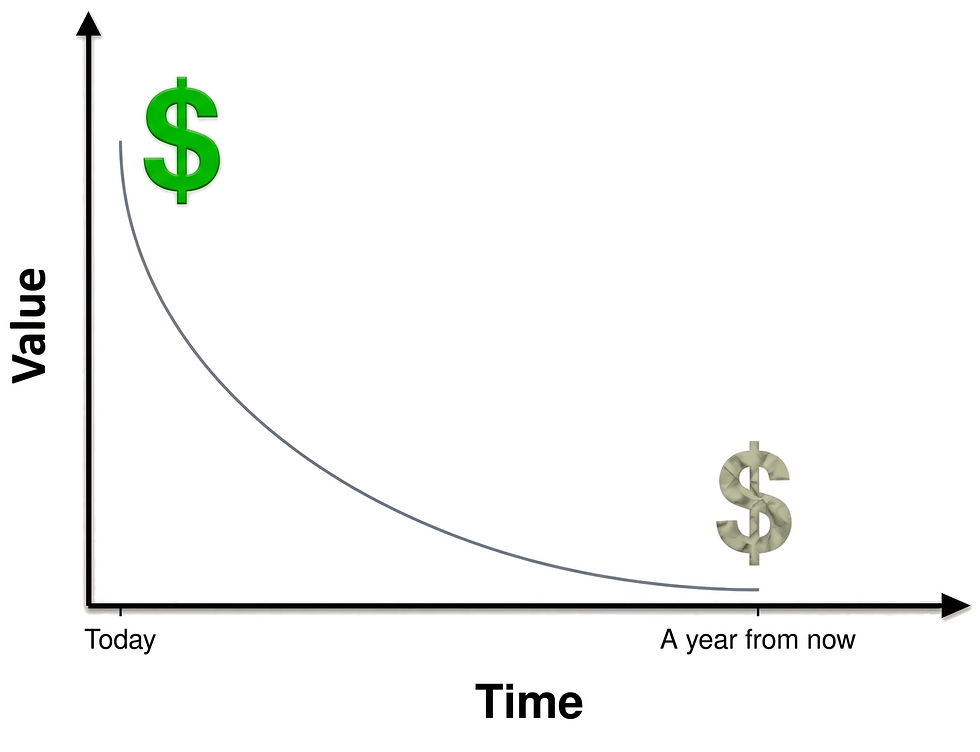
Surprisingly, given some assumptions that are standard in the classic literature on this topic, there’s only one such curve that appears to be compatible with rational decision-making, and that’s an exponential curve. That’s because it turns out that without an exponential discount curve, a very strange thing can happen where you seem to contradict your own preferences.
Suppose someone offers you either $100 today or $101 in one week. You might just say, “Ah, I'll just take the $100 today.” Fine, seems reasonable.
But now imagine that someone offers you $100 in one year or $101 in one year and one week. In that case, you might think, “Well, I’ll just take the $101 in one year and one week. If I’m already waiting a year, what is one extra week? It doesn’t really mean anything. I’ll take the $1.”
But if you answer both those ways, which some people do, it will cause you to contradict yourself. The reason it’s a contradiction is because after waiting one year, you’ve now gotten yourself exactly into the scenario where you made the other choice. After one year, you now have the option of $100 today or $101 in one week. And you’ve said you prefer $100 today, which contradicts your prior choice.
We can avoid contradictions like this if we discount both offers exponentially at the same rate, producing consistent choices. The problem is that when researchers actually measured people’s choices, those choices didn’t work that way. Instead, people tended to show more impatience for short delays in the near future than for the same delays further in the future. A hyperbolic function can capture this pattern, hence the name “hyperbolic discounting”. Researchers also use other models, including “quasi-hyperbolic discounting”, which a recent meta-analysis referred to as “the dominant model of self-control failures in behavioral economics.”

Is Hyperbolic Discounting Rational?
This has long been used as an example of human irrationality. But more recently, researchers have offered a really interesting critique. They asked the question, “What if you're uncertain about what your discount rate is?” For example, what if you don't know the likelihood you’ll be in debt in the future, and that could change how much you value a dollar today versus a dollar tomorrow? Or you don’t know how likely you are to be alive in the future, and that also changes the value of a dollar today versus tomorrow.
They demonstrate that, taking into account this uncertainty, you actually can end up rationally with something similar to a hyperbolic discount curve. In other words, something more similar to what humans actually have.
Final Thoughts: How Rational Are Humans?
So where does this all leave us? A number of cognitive biases have now been challenged. People have argued that, actually, when you think about real-world behavior, it’s hard to say “this is a genuine bias.” It may be, but it also may not be, and whether it is depends on details of the scenario.
Many of the hypothetical scenarios used to demonstrate human irrationality lack real-world richness, which makes it harder for them to actually prove we’re being irrational. Often, human heuristics can be smarter than they seem at first. And we have to grapple with the fact that the real world is messy and rarely resembles these clean hypotheticals closely.
That being said, we also think there is abundant evidence that humans often are genuinely irrational. We might sometimes be justified in believing in the gambler’s fallacy, but people also go to Las Vegas and believe in it there, where it absolutely does not apply! We might sometimes be justified in hyperbolic discounting, but people also sometimes take on loans with 30% interest rates, even in situations when it’s absolutely not in their best interest. There are many ways to be irrational, and we are all irrational at times. Nevertheless, we believe that seeking to be more rational is an endeavor well worth pursuing. That includes aiming to see the world as it truly is, and aiming to act in alignment with your beliefs and values.
If you want to explore the topic of rationality more, check out our free “How Rational Are You, Really?” test. It’s been taken by hundreds of thousands of people.
And if you want to explore how to live a more rational life aligned with your values, check out the new book by Spencer Greenberg (founder of Clearer Thinking and author of this article) and Jeremy Stevenson, The 12 Levers: The Complete Psychological Toolkit for Improving Your Life.
If you found this article interesting, you might be interested in subscribing to Spencer’s YouTube channel, where he puts out a new video on psychology just about every week. We'd love to see you there.


