
What are the policies that everyone wants to vote for, regardless of their political orientation?
Updated: Jul 21

Short of time? Read the key takeaways.
🪢 Politics can feel like an endless tug-of-war that leads to gridlock. We wanted to know whether there are policies that people across the political spectrum already agree on. Such policies might offer a way to improve people's lives without needing to first resolve our deepest disagreements.
🗳️ We found dozens of policies that appealed to people on the political Left, Center, and Right alike. In each case, even the least receptive ideological group said that they'd be more likely to vote for a political candidate who supports these policies.
🏛️ Some policy areas proved much more promising than others. Government accountability, consumer protection, the economy, public health, and AI produced the strongest cross-partisan support, while finding similarly popular ideas in other domains was much harder.
⚖️ The most popular policies remained broadly appealing even after people considered arguments on both sides. Hearing both the pros and cons reduced support slightly, but it did not substantially change the overall pattern of results.
🌱 Our findings suggest that political progress doesn't have to depend only on resolving the most divisive issues. There may be many opportunities to improve people's lives by advancing policies that already enjoy broad support across the political spectrum.
What’s the point of politics? Thomas Hobbes gave probably the most famous answer: according to him, political entities (chiefly the nation state) exist to give us an escape from the lawless “state of nature”, which he described as a war of all against all, wherein life is “solitary, poore, nasty, brutish, and short.”
But there are more optimistic views out there. Instead of arguing (like Hobbes) that politics is primarily for the avoidance of harm, Aristotle and Confucius argued that the purpose of politics is to establish the conditions for human flourishing.
It’s a nice idea, that the purpose of politics is to make all our lives better. Yet, watching politics play out in the world today, it can seem like constant bickering and fighting make progress and improvement impossible. Empirical evidence supports this: researchers frequently find that party polarization is a key cause of legislative “gridlock” or “stasis”, that inhibits the passage of laws, regulations, and budgets even more than divided government does. Even when something happens, it's often one party shifting things one way only to have it shifted back by the opposing party soon afterward, in an incredibly costly game of tug-of-war.
All of this conflict makes it seem like there's nothing that different political groups can all agree on: they simply differ too much in terms of what they want the world to be like, and what they think is true.
But what if that's wrong?
We wondered:
Is it possible to develop a platform of policies that are liked by people all across the political spectrum in the US - that is, progressives and centrists and conservatives?
If so, what are these policies?
What would this platform look like?
Could someone run on this platform, or is it for some reason untenable?
So we ran two large studies to find out. We focused on the US context.
Honestly, we weren't sure whether we would find anything worth reporting on, since groups are so polarized. But, we were happy to discover a variety of popular and unpolarized policies that have the potential to improve people’s lives and even garner support from voters. To whet your appetite, here’s a sample of the policies we found were widely supported and that people said would make them want to vote for someone:

And that’s only a sample. This provides evidence that, instead of spending all one’s political energy fighting on axes where people vehemently disagree, it is possible to seek improvements on axes where people agree, and thereby more easily make society better and better.
Of course, some fights really are warranted and important (we’re not saying politicians should never fight over policy!), but it’s possible that in all the fighting, we’re missing out on a great deal of low-hanging fruit in the form of widely-appealing policies that could make people’s lives better. Read on to discover what we found.
In reading this, you might also discover more about your own views, such as policies you support that you've never thought about before.
We’ll start by saying a little bit about the design of the two studies we ran. If you don’t care to get bogged down in these details, feel free to skip ahead to the section below titled “Results.” And if you want even more methodological detail than we give in this article, you can check out the full report, here.
How Our Studies for Finding Popular Policies Worked
We started by drafting a long list of policy ideas that we thought might stand a chance of being popular with people regardless of party (even though we didn’t personally agree with all of them). We brainstormed ideas ourselves, crowdsourced from social media, and even asked LLMs for suggestions. We settled on a list of 195 different ideas, including things like:
Ban Legislator Stock Trading (Prohibit senators and representatives from trading stocks to avoid conflicts of interest)
Ban Non‑Compete Agreements (Make most employer–employee non‑compete clauses illegal to promote labor mobility and innovation)
Make Assisted Dying Legal (Allow patients to seek physician‑assisted assistance in ending their life so long as they do so willingly and with sound mind)
Since there are people who believe that (as the philosopher Jeremy Bentham put it), “Every law is an evil, for every law is an infraction of liberty” we made sure that our proposals contained a mix of positive proposals for new laws or regulations and also negative proposals to remove existing laws or regulations. If you’re interested, you can download the full list here.
Our goal was to include a very wide range of ideas that had at least some chance of being widely viewed as good (whether or not we thought they were good), but of course, the list was far from exhaustive, and it's likely we missed some great ideas.
In our first (more preliminary) study, we recruited 346 U.S. participants through the participant recruitment platform Positly.com (a sister project of ours), and balanced the sample roughly across people who identified as being on the Left (37%), in the Center (31.2%), and on the Right (31.8%). Each participant saw a random subset of 75 policies. For each of those policies, they saw the name, a short description, and two arguments in favor, then rated how much they supported it becoming law or regulation in the U.S.
We then looked to see which (if any) policies were such that the average rating of people on the left, the average rating of people in the center, and the average rating of people on the right were all above “slightly in favor.”
How many policies would you expect this to be? Part of the reason we included so many policies in our preliminary study is that, given the intense polarization in the U.S., we expected widely-popular policies might be very hard to find. If so, that would give reason to expect that there are not many policies for which all group averages were above “slightly in favor.” Well, we were shocked to discover that 95 of our potentially popular policies clear that bar! That’s a lot of promising policy ideas! We’ve listed them all in Appendix A of the study’s full report. Those were the policies we took into our second study.
In our second study (which we also refer to as the “main” study), we recruited 551 U.S. participants (again through Positly.com), roughly balanced across the Left (32.5%), Center (36.7%) and Right (30.9%) of the political spectrum. This time, we showed each participant 60 policies and asked each participant two questions about each:
How much are you in favor of this policy becoming law or regulation in the US?
To what extent would seeing a political candidate advocate this policy make you want to vote for them (regardless of party)?
Since it’s possible to like a policy a lot, without it being important enough to you to affect how you vote, we based most of our analysis on the answers to the second question. Our hope is to identify policies that could form a viable political platform.
As an additional test, we also randomly assigned each participant to one of two experimental conditions: one condition group was shown two arguments for and two arguments against each policy, while the other was not shown any arguments. For each participant who was shown arguments, it was randomized whether they were shown the arguments in favor before or after the arguments against.
We then asked participants a series of demographic questions about their political leanings, religiosity, class in society, and how urban/rurally they live.
Results
Let’s go through the most important things we found.
Remember that we were looking into policies that are broadly liked, across the political spectrum. To measure how much a policy is broadly liked across the political spectrum, we used a variable that we called “minimum group appeal,” which is defined as follows: for each policy, its minimum group appeal is the lowest number from among (a) the average of the answers given by people classified as Left, (b) the average of the answers given by people classified as Right, and (c) the average of the answers given by people classified as Center, to the question “To what extent would seeing a political candidate advocate this policy make you want to vote for them (regardless of party)?”
Thus, a policy can only have a high minimum group appeal if it is not disliked on average by any of the three ideological groups.
Result 1: What were the best performing non-partisan policies?
So, what does a non-partisan political platform look like? One that transcends partisan boundaries and appeals to people from the Left, Center, and Right. The image below shows the 28 policies we identified that each had a minimum group appeal of 1 or greater (on a scale of -3 to 3), meaning that even the least receptive ideological group reported that seeing a candidate advocate the policy would increase their likelihood of voting for them (at least “slightly”).
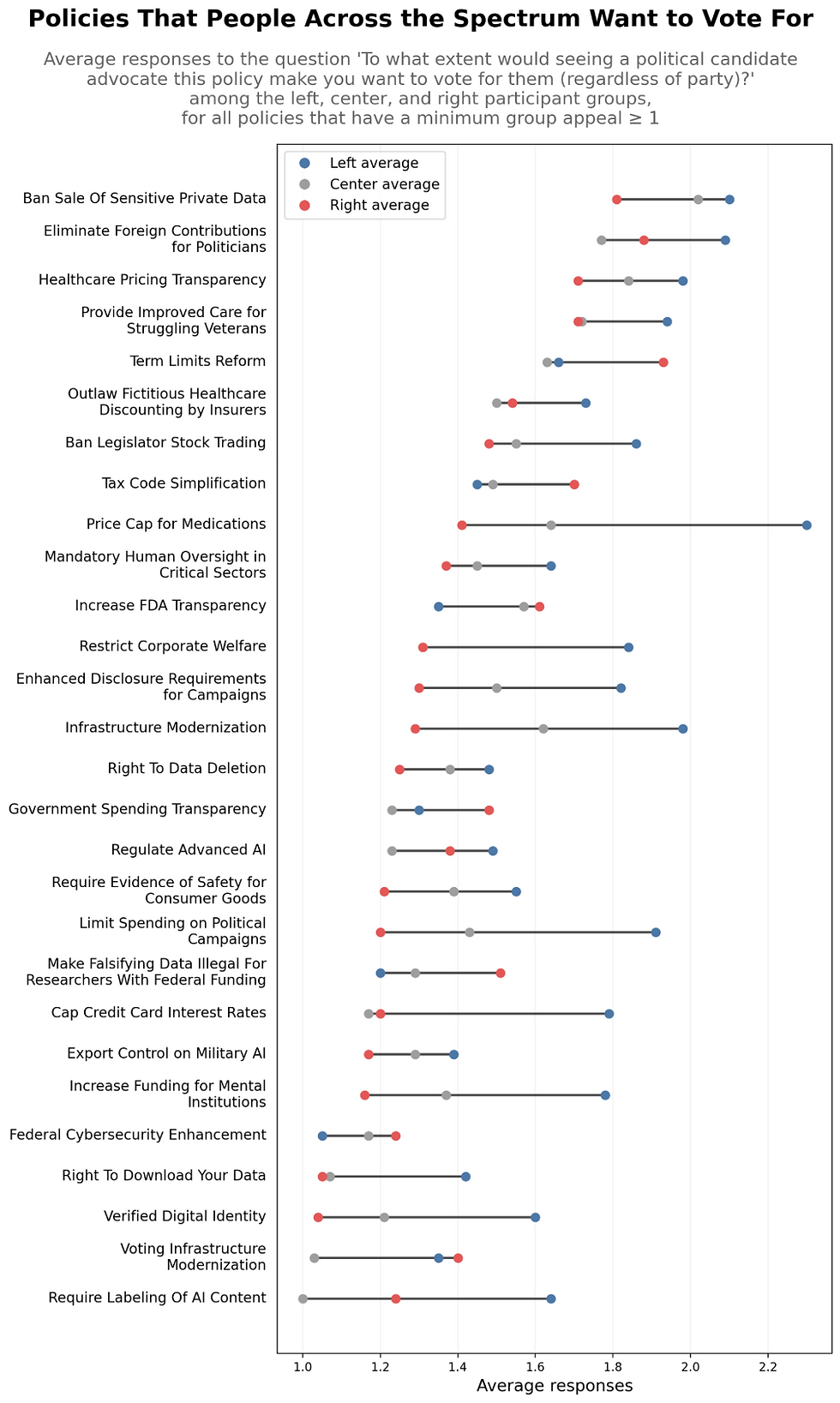
Above are the “policies that all groups want to vote for.” They represent candidates for a potentially viable non-polarized political platform; ways it may be possible to make society or people’s lives better while reducing the gridlock of polarized politics.
Result 2: Which categories were most appealing across the spectrum?
We assigned each of the policies we examined in this study a category. Some categories performed better than others, as shown in this chart:
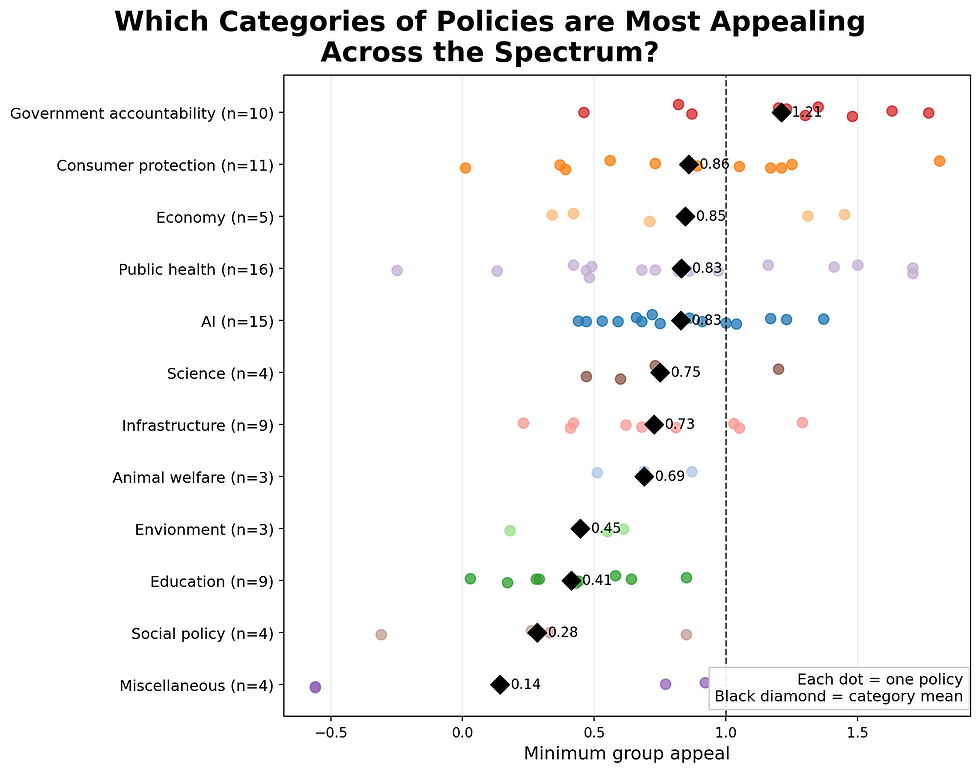
Each colored dot to the right of the dashed line (at x=1) represents a candidate policy that is included in our “policies that people across the spectrum want to vote for,” chart from the previous section (Figure 1). Of course, the line could have been drawn elsewhere, but a (somewhat arbitrary) choice had to be made.
This shows that, when it came to thinking of policies that could motivate people across the political spectrum to vote for a politician, we had the most success with policies in the Government Accountability category, followed by Consumer Protection, Economy, Public Health, and AI.
The fact that policies in other categories had lower minimum group averages (as well as category means) might be because US Americans really do generally agree more on the higher scoring topics and less on the lower scoring ones. Alternatively, it might be because we simply failed to generate non-partisan, highly and broadly appealing social, education, environmental, or animal welfare policy ideas; no policies from those categories made it into our “policies that all groups want to vote for” list. We believe that finding widely supported policy proposals in these categories is a worthwhile endeavor for future research. If you have ideas, feel free to email them to us, at info@clearerthinking.org - we’d be interested to hear them!
Result 3: Did being shown arguments affect the outcomes?
As mentioned, each participant was randomly assigned into one of two experimental groups:
Those in the pros and cons group were shown two brief arguments in favor and two brief arguments against each policy, before being asked to give their responses.
Those in the control group were not shown arguments for and against the policies (though just like the other group, they saw a description of the policy)..
We used a mixed-effects model to predict participants’ mean response, based on whether participants were in the pros and cons group or not, while accounting for the fact that some participants are generally more extreme than others, and some policies naturally elicit stronger reactions than others.
The results of this analysis indicate a small but statistically significant reduction in response associated with being assigned to the pros and cons group (β = −0.16, p = 0.005). This means that participants who were shown pros and cons gave responses that were (on average) around 0.16 points lower on the response scale (which ranges from -3 to 3) than those who were not shown pros and cons, after accounting for differences between participants and policies. A plausible explanation for this is that perhaps being shown arguments for and against something tends to slightly temper people’s responses to it. However, the 95% CI barely excludes zero [-0.273, -0.047], suggesting substantial uncertainty about the effect size.

When policies get picked up by politicians and incorporated into their political platforms, those policies tend to get debated — which means people get exposed to arguments for and against those policies. Hence, these results give reasons to wonder whether the policies we’ve identified would be less popular or less vote-incentivizing once they make it into a real policy platform. However, since the effect size is very small, it is unlikely that this would reliably or substantially undermine the usefulness of the results of this study.
Limitations regarding what policies would be viable
We sought to find policies that are broadly liked, across the political spectrum, because we theorized that they could provide easy ways to improve people’s lives, without encountering the usual stasis faced by more partisan policies. This relies on the assumption that, for any given policy, if people across the political spectrum would (on average) vote for a candidate supporting a given policy, then that policy is likely to face fewer challenges in becoming law. In reality, at least the following two kinds of problems could undermine this assumption:
1. For any given policy, there might be reasons other than its polarizing nature that cause lawmakers to delay or frustrate its passage into law.
We expect this to be the case with some of the policy proposals we have highlighted in this article. For instance, any policies that would impose greater scrutiny on or accountability for lawmakers are likely to face challenges from those very lawmakers, regardless of how polarized the policy is among the voting public.
Similarly, politicians face pressures from volunteers, wealthy donors, and their own political parties, and those forces can push them to support or oppose specific policies, whether or not they have broad public support.
Despite these concerns, we think it is worth investigating anyway; even if such policies would face frustration from lawmakers, it is interesting to discover (as our results suggest) that candidates running on platforms that include such policies would be likely to gain increases in public support across the political spectrum.
2. It could be the case that the only reason these policies aren’t highly polarized, partisan policies is that they haven’t yet been advocated loudly by politicians. Perhaps, as soon as a Democrat or Republican sticks their flag in any of these policies, those policies will become divisive and thereby face the usual delays.
In support of this concern, there is decades of experimental evidence (also discussed here) suggesting that people use “party cues” (such as the policy positions advocated by the leader of their preferred party) as important determinants of their views on policy. However, the most comprehensive scholarly review of the literature to date reports that more recent studies (which don’t have some of the methodological flaws of older studies) consistently find that “party cues do affect [people’s] views of the policy under consideration–but, on average, information about the policy matters more.” This suggests that, although politicians might be able to have some negative effects on people’s views of currently-popular policy, they won’t typically be able to eliminate those policies’ broad appeal altogether. Hence, there is still practical usage to identifying policies with broad cross-ideological appeal, even in a highly polarized political environment.
Finally, another limitation of the studies presented here is that they relied on the imaginations of a handful of researchers, crowdsourcing, and LLMs to draft potentially popular policy proposals. It’s possible that some of the findings discussed in the Results 2 and Results 3 sections would be slightly different under a different set of policies. To that end, we’d love to see this research replicated with other policy sets.
What does this all mean?
The main findings of this research have been that:
There really are policies that have broad popularity, across the political spectrum, with people from the Left, Center, and Right all reporting that seeing a candidate advocate such policies would increase their desire to vote for that candidate.
When it comes to having broad agreement, some categories of policy may perform better than others. We had the most success finding policies with a high minimum group appeal in the Government Accountability category, followed by Consumer Protection, Economy, Public Health, and AI. We found it more difficult to identify non-partisan, highly and broadly appealing social, education, environmental, or animal welfare policies.
Showing people arguments for and against policies may have a tempering effect on their reactions, but it appears to be a small effect.
Modern political discourse seems to be constantly dominated by highly divisive, highly polarized issues. Yet our findings give reason to think that, even in this political climate, there may still be many opportunities for making people’s lives better through policies that enjoy near-unanimous group-level approval. Some fights are absolutely worth having, but it may be useful to remember that instead of only tugging the rope of politics back and forth, we can seek out sources of agreement about what's good and, in so doing, more easily obtain more of what some have called the purpose of politics: human flourishing.


